miércoles, abril 14, 2010

EPIPHYTIC GROWTH HABITS OF CHILEAN GESNERIACEAE AND THE EVOLUTION OF EPIPHYTES WITHIN THE TRIBE CORONANTHEREAE


M. Fernanda Salinas, Mary T. K. Arroyo and Juan J. Armesto


ANNALS OF THE MISSOURI BOTANICAL GARDEN 97: 117–127. PUBLISHED ON 31 MARCH 2010.


Three monotypic and endemic genera of epiphytic Gesneriaceae (Gesnerioideae, Coronanthereae) occur in temperate rainforests of southern South America. In this article, intraspecific differences in rooted substrate and interspecific variation in epiphytic growth habits among these three Gesneriaceae species were assessed. The presence or absence of plants on the ground and main rooted substrate when growing epiphytically on trees were used to characterize epiphytic growth habits in two old-growth temperate rainforests of northern Chiloe´ Island in Chile. An evolutionary interpretation based on reported phylogenies and morphologies within the Coronanthereae is proposed. Two species of Chilean Gesneriaceae, Mitraria coccinea Cav. and Asteranthera ovata (Cav.) Hanst., originate from the forest floor, then climb on trees while maintaining their main roots in the ground, and are classified as secondary hemiepiphytes. The third species, Sarmienta repens Ruiz & Pav., was found exclusively on tree trunks and branches of living and dead trees and thus may be classified as a holoepiphyte. Based on reported phylogenies and biogeographical, ecological, and morphological data, the mechanically independent arboreal habit appears to be the ancestral condition in the Coronanthereae, which in turn gave rise to the climbing habit and finally the holoepiphytic habit. This may be a common evolutionary pathway toward holoepiphytism within other lineages in the Gesneriaceae.

lunes, abril 05, 2010

Behavioral development not Genetic Kin Selection!...may explain origins of sociality


It has been proposed that one of the traits that are involved in the origin of sociality is the tolerance among individuals belonging to the same species. This means that the transition from solitary to social life requires the regulation of aggressiveness and the evolution of intraspecific recognition. This is also known as kin recognition, now, when we look at the ideas to explain the origin and maintenance of this trait, there are some contrasting approaches.

The sociobiological school, propose that individuals bearing the same genes may be able to recognize themselves, this correspond to an evolutionary adaptation that allow them to collaborate and keep cohesion of related group of individual. This idea has flourished in the field of behavioral ecology and the mainstream neodarwinian culture, it has been suggested even to explain altruism in humans. However, despite the benefits suggested on the theoretical models for a genetic kin selection, these proposals are often not supported with explanatory mechanism for the occurrence of such kin recognition.

Alternatively to this approach, it have been suggested that the recognition and acceptance of individuals belonging to a defined group correspond to an emergent property due to behavioral development, where the signals present during the construction of the kin fidelity responses are molded by the available cues, these cues can originated either in the group (kin reference) or even derive from the organism itself that is developing its responses (self reference).


One suitable system to study the jump from solitary to social life and the origin and maintenance of intraspecific recognition is constituted by the Xylocopinae (Hymenoptera: Apidae). This group is held as the sister group for all other Apidae subfamilies, and thus it may very likely be the less derived. In addition it contains species that goes from solitary to social life in relation to nesting behavior. Among the solitary species some exhibit features more often present in social species, some of these are related to parental care, contact between related individuals and also tolerance between nestmates. Manueli apostica is one of these solitary bees, it belong to the monogenerial tribe Manuelini inside Xylocopine, a group mainly presented on continental Chile. In these bees, female construct nests inside the dead stem of Chusquea quila (Poaceae: Bambuseae), in these developing offspring are isolated by the mother in single compartments together with food supplies (Figure 1).

In this group, Dr. Luis Flores-Prado and collaborators from Facultad de Ciencias, Universidad de Chile,  have found that the recognition of nestmates individuals and tolerance is either developed from cues present on food masses and nest material provided by the mother or on cues acquired by the insect themselves, also known as self referencing (Experiment 1, Figure 2). In a newly published research Dr Flores-Prado and co. performed a recognition test between two non-kin individuals (a foster and a non manipulated one, Experiment 2, comparison A) developed in the same nest, thus they will experience the same breeding environment.

Furthermore, they compared between two kin females developed in different nest, which were not used as sources of other test (Experiment 2, comparison B). So, this means same kin different environment.


These transplant design allow them to disentangle if kin recognition is achieved due to the cues from food provisioning or from cues that the bee obtain from itself. These experiments demonstrated that non-kin females developed in the same nest were more intolerant (and less tolerant) with each other than kin females developed in different nests (Figure 3). Thus, kin recognition was occurring. Individuals of M. postica are physically isolated while developing up to the adult stage prior to the destruction of cell partitions, and there is no direct contact between them and their mother after oviposition. In addition, non-volatile compounds (such as cuticular hydrocarbons) mediate nesmate recognition in this specie (at has been demonstrated by Dr. Flores-Prado). Based on these evidences the authors suggest that cues used in this “kin” recognition do not correspond to an especially unique kin cues and that kin recognition in this bee specie has occurred through self-referent phenotype matching. Just in the same way chicken embryos are able to develop its how-to-peek on a spot behavior due to the cues derived from the movements of their own organs inside the egg, one of the many amazing examples of behavioral developments discovered by Z.Y. Kuo in the beginning of the XX century. 


Cristian Villagra 


References

Flores-Prado L Chiappa E & Niemeyer HM Nesting biology, life cycle, and interactions between females of Manuelia postica, a solitary species of the Xylocopinae (Hymenoptera: Apidae). 35:93-102.

Flores-Prado, L. Aguilera-Olivares D. & Niemeyer H.M. 2008 Nest-mate recognition in Manuelia postica (Apidae: Xylocopinae): an eusocial trait is present in a solitary bee. Proc. R. Soc. B 275, 285–291.

Flores-Prado L & Niemeyer HM 2010 Kin Recognition in the largely Solitary Bee, Manuelia postica (Apidae: Xylocopinae). Ethology 115:1–6.

Hamilton, W. D. 1964a The genetical evolution of social behavior, I. J. Theor. Biol. 7, 1–16.

Hamilton, W. D. 1964b The genetical evolution of social behavior, II. J. Theor. Biol. 7, 17–52.

Mateo, J. M. 2004: Recognition systems and biologicalorganisation: the perception component of social recognition.Ann. Zool. Fenn. 41, 729-745.

Michener CD 2000. The bees of the world. Baltimore, Maryland, The John Hopkins University Press. 913 p.


jueves, febrero 25, 2010

A pergunta que Einstein fez à Biologia

A Biologia inteira é muito grata à iniciativa de se personificar processos em moléculas. Chegamos até aqui empurrados pelo valor prático de se tratar o organismo como algo composto de partículas muito bem definidas que podem ser isoladas dos processos que participam e estudadas minuciosamente. Tratamos a herança como transmissão de partículas e cá estamos na era pós-genomica. Mas, a despeito do genoma humano, não entendemos muito bem sobre os processos gerativos e conservativos do viver. Neste contexto, quero aqui relembrar uns experimentos antigos que são seríssimos e depois quero terminar com a pergunta que Einstein fez à Biologia.

Entre as salamandras Triturus viridescens é comum a ocorrência, natural ou induzida, de poliploidia. Particularmente, o embriologista Frankhauser trabalhava na década de 40 com salamandras que podiam ser haplóides, diplóides ou pentaploides. Era uma situação muito curiosa porque existe uma relação muito linear entre o número de cromossomos e o volume celular: as células que tinham 5 vezes o número de cromossomos eram realmente muito maiores que as células haplóides. Entretanto, e aí está o curioso, Frankhauser observava que as salamandras pentaplóides ou haplóides tinha os órgãos e o corpo com o mesmo tamanho que as salamandras haplóides. Isso acontecia devido às compensações no número de células que compunham cada um dos órgãos. A figura mais conhecida deste trabalho eu mostro abaixo, que trata do diâmetro dos ductos pronéfricos. Percebam que interessante, não importa o tamanho das células, o diâmetro dos ductos pronéfricos é conservado o mesmo porque nas salamandras haplóides esses ductos são feitos de 6-8 células, mas nas salamandras pentaplóides eles são constituídos de 1-2 células. Mudam os componentes, segue conservada a forma. A condição sistêmica grita forte nesse caso!


Agora vejam que interessante: logo depois de publicar este artigo em 1945, Frankhauser recebeu uma carta do físico Albert Einstein com a seguinte colocação:

" It is really marvel, the living being. The fact alone that the thing can exist with the three or four fold crhomosome number is extremely remarkable. Most peculiar, however, for me is the fact that, in spite of the enlarged single cell, the size of the animal is not correspondingly increased. It looks as the importance of the cell as rulling element of the whole had been overestimated previously. What the real determinant of form and organization is seems quite obscure."

Parece que os problemas biológicos ficam mais claros para quem está de fora da Biologia. Que resposta temos a oferecer a Einstein, tanto tempo depois?

Abraços,
Gustavo

Referencias:
Frankhauser (1945) Maintenance of normal structure in heteroploid salamander larvae, through compensation of changes in cell size by adjustment of cell number and cell shap. J Exp. Zool.00(3) pags. 445-455

domingo, noviembre 08, 2009

Evolution and Development: A predictive science

HYPOTHESIS: 

Vargas A. 1999 The evolution of Arm Size in Theropod Dinosaurs: A Developmental Hypothesis. Noticiario Mensual MNHN Chile. 338:16-19. PDF


CONFIRMATION:

Bybee PJ, Lee AH, Lamm E.  2006 Sizing the Jurassic Theropod Dinosaur Allosaurus: Assessing Growth Strategy and Evolution of Ontogenetic Scaling of LimbsJOURNAL OF MORPHOLOGY 267:347–359 (2006)


" (..) regression analyses suggest that relative to the length of the femur, the lengths of the humerus, ulna, and tibia increase in length more slowly than isometry predicts"


Traducción: 

"los análisis de regresión sugieren que en relación al tamaño del fémur, las longitudes del húmero, ulna y tibia aumentan en longitud más lento de lo que predice la isometría"


miércoles, octubre 14, 2009

Symbiosis and adaptation


Associações entre plantas e fungos não são novidades; todos conhecem bem a historia das micorrizas. Mas diferente desse tipo de associação mais de fronteira entre a planta e o solo (que muitas vezes é comparado com a microbiota estabelecida em nossa pele ou intestino), há um mundo interessantíssimo de associações com fungos e bactérias que vivem entranhados no parênquima vegetal – os endófitos.

Bom, reconheço que essa associação não é uma grande novidade, já se sabe disso há algum tempo. Entretanto esta situação passou a ganhar maior atenção recentemente a partir do instante em que se observou que sempre que se fazia um PCR de extratos vegetais puros, aparecia junto a amplificação de seqüências fúngicas. Vale dizer que essa associação endofítica foi, até o presente, encontrada em TODAS, as plantas analisadas. Vou repetir: TODAS. Nesse contexto há duas situações dignas de post (e que creio ter feito a Margulis feliz, jajaja).

1) No parque nacional Yellowstone (aquele dos Geisers), existe uma flora muito particular e “perfeitamente adaptada” aos solos com altas temperaturas e alta acidez. Encontrou-se que a planta Dichanthelium lanuginosum (Fig esquerda), só é capaz de agüentar tais condições ambientais devido a uma associação que faz com o fungo endofítico Curvularia protuberata. Dissociados, nem planta nem fungo, vivem em temperaturas maiores que 38ºC! Mais interessante ainda: esta resistência parece depender de um segmento de RNA viral presente no fungo. Se o fungo não estiver infectado, não há resistência!

2) Um outro exemplo de adaptação à habitats mais extremos conferido por este tipo de associação também ocorre com uma planta de restinga, que cresce em dunas de praias. Encontrou-se que a resistência a salinidade de plantas Leymus mollis (Fig direita) nas regiões costaneiras se deve a uma simbiose com um fungo endófito Fusarium culmorum. Curioso que são plantas de dunas, adaptadas a serem plantas de dunas, mas, se se tira este fungo que está lá dentro junto ao sistema vascular da planta, elas não sobrevivem nas dunas.


Creio que estas associações são muito interessantes e muito sérias pois estão na gênese do estabelecimento de um modo de viver particular. Uma construção de nicho que depende do encontro de duas ontogêneses!


Por fim, mas não menos importante, cabe ressaltar que encontrei estes exemplos estudando imunologia, porque esta também é uma situação interessante desde o ponto de vista do adoecer. Digo isso porque se saco uma espécie de fungo que faz associação mutualista com um cultivar de tomate e o coloco (este mesmo fungo) em outro varietal de tomate (mesmo background genético), então surge uma associação parasitóide e uma planta doente. Isso nos mostra claramente que o adoecer não é causado por uma bactéria agressora e invasiva, mas sim um resultado que emana de um estabelecimento ou não de uma relação particular entre os dois organismos. Isso é muito diferente da idéia de microorganismos como agencias causadoras do adoecer – uma antiga idéia de Pasteur que ainda é muito aceita na Imunologia atual. Por esses e outros motivos queremos tanto que Biologia e Imunologia se reencontrem.

Até Dezembro,

Gustavo

Referencias

Gilbert, SF. Ecological Developmental Biology: Integrating Epigenetics, Medicine, and Evolution. 2008.

Rodriguez R; Redman R. More than 400 million years of evolution and some plants still can’t make it on their own: plant stress tolerance via fungal symbiosis. Journal of Experimental Botany, Vol. 59, No. 5, pp. 1109–1114, 2008

viernes, octubre 09, 2009

Limusaurus and bird digit identity


Vargas AO,  Wagner GP and Gauthier, JA. 2009. Limusaurus and bird digit identity. Available from Nature Precedings   PDF

Limusaurus is a remarkable herbivorous ceratosaur unique among theropods in having digits II, III and IV, with only a small metacarpal vestige of digit I1. This raises interesting questions regarding the controversial identity of avian wing digits. The early tetanuran ancestors of birds had tridactyl hands with digital morphologies corresponding to digits I, II & III of other dinosaurs2. In bird embryos, however, the pattern of cartilage formation indicates that their digits develop from positions that become digits II, III, & IV in other amniotes3. Limusaurus has been argued to provide evidence that the digits of tetanurans, currently considered to be I, II and III, may actually be digits II, III, & IV, thus explaining the embryological position of bird wing digits1. However, morphology and gene expression of the anterior bird wing digit specifically resemble digit I, not II, of other amniotes4,5. We argue that digit I loss in Limusaurus is derived and thus irrelevant to understanding the development of the bird wing. 

If the extremely reduced hand morphology of Limusaurus was once present in the ancestors of birds (Figure 1A), several traits of digits I, II & III must have been lost (Figure 1A, step 1) and then re-evolved on digits II, III & IV (Figure 1A, step 2)1. The alternative is for the extremely reduced morphology of Limusaurus to have evolved in Ceratosauria, while bird ancestors retained digits I, II & III (Figure 1B). Quantitative analysis only favors the II,III,IV identification of tetanuran digits when bird digits are coded as II,III,IV, a category assumption based on embryological position alone1. This is not a truly integrative comparison, since it excludes phalangeal and metacarpal similarities that bird digits share with digits I, II and III of other theropods. When this assumption is removed, the I,II,III identification of tetanuran digits is most parsimonious1.

Rather than assume the priority of either morphological or embryological data, we propose that a homeotic frameshift occurred in the bird line, such that digits I, II, & III develop from embryological condensations 2, 3 & 46. That hypothesis has been supported by the observed absence of expression of most HoxD genes (HoxD-10, HoxD-11 and HoxD-12) only in the anterior digit of the embryonic wing, a feature diagnostic of digit I of mouse4;HoxD-11 expression in alligator is also absent only in digit I5. Experiments applying Cyclopamine (a down-regulator of Shh signaling) to the early wing bud show a frameshift of both digit morphology and HoxD-12 expression with regard to the pattern of cartilage formation, viz., anterior and middle digits now develop from positions 3 and 4, and the posterior digit normally developing from position 4 is lost7. In our scenario (Figure 1B), a similar frameshift occurred in the raptorial forelimbs of bird ancestors (Figure 1B, step 2), probably upon loss of digit IV in early Tetanurae6,7. The frameshift would be unrelated to digit I loss in the extremely reduced forelimbs of Limusaurus (Figure 1B, step 1). A few metacarpal traits of tetanurans resemble those of digits II,III & IV of other theropods1.  The frameshift could have affected all but these few de-coupled traits, which may provide a morphological signature of the occurrence of the frameshift towards the origin of Tetanurae.

It is debatable whether digit morphologies can disappear and re-appear in a different position, and whether such a step-wise process could be considered a homeotic frameshift (as suggested by Xu et al.). While Limusaurus expands our knowledge of digit reduction in theropods, it does not support a strong inference that any loss and re-gain of digital morphologies has actually occurred in the lineage leading to birds.

Alexander O. Vargas1, Günter P. Wagner2 and Jacques A. Gauthier3.

1Departamento de Biología, Facultad de Ciencias, Universidad de Chile, Santiago, Chile. e-mail: thearchosaur@gmail.com

2Department of Ecology and Evolutionary Biology, Yale University, New Haven, Connecticut, United States of America

3 Department of Geology and Geophysics, Yale Peabody Museum of Natural History, New Haven, Connecticut, United States of America


Figure 1. Alternative interpretations (A and B) of Limusaurus and the evolution of bird digit morphology. A) Limusaurus represents the morphology of bird ancestors; this implies extreme digit reduction occurred (Step 1: loss of digit I, loss and shortening of phalanges), but thereafter normal I, II, III morphologies re-appeared on digits II, III and IV (Step 2). B) Limusaurus does not represent the morphology of bird ancestors. Extreme digit reduction occurred only in Ceratosauria (Step 1); we propose that a homeotic frameshift accompanied the loss of digit IV (orange) in Tetanurae (Step 2), such that morphology and gene expression of digits I, II and III occur at embryological positions 2, 3 and 46. Colours indicate digit identity according to number of phalanges, morphology and gene expression. The number of phalanges developing at each inferred embryological position is indicated under each hand (x means complete loss of the adult digit). Image modified from Xu et al.1

  1. Xu, X., et al. A Jurassic ceratosaur from China helps clarify avian digit homologies. Nature 459: 940-944 (2009)
  2. Gauthier, J. A. Saurischian monophyly and the origin of birds. Mem. Calif. Acad. Sci. 8: 1–55 (1986)
  3. Müller, G.B., and Alberch, P. Ontogeny of the limb skeleton in Alligator mississippiensis: Developmental invariance and change in the evolution of archosaur limbs. J. Morphol. 203: 151–164 (1990)
  4. Vargas AO, Fallon JF. Birds have dinosaur wings: The molecular evidence. J Exp Zool  (Mol Dev Evol) 304B: 86–90. (2005).
  5. Vargas, A.O., Kohlsdorf, T., Fallon, J. F., Brooks, J. V. & Wagner, G. P. The evolution of HoxD-11 expression in the bird wing: insights fromAlligator mississippiensis. PLoS ONE 3, e3325 (2008).
  6. Wagner, G. P. & Gauthier, J. A. 1,2,3 = 2,3,4: a solution to the problem of the homology of the digits in the avian hand. Proc. Natl. Acad. Sci. USA 96, 5111–5116 (1999).
  7. Vargas, A.O. & Wagner GP. Frame-shifts of digit identity in bird evolution and Cyclopamine-treated wings. Evolution & Development 11: 163-169 (2009)

domingo, septiembre 06, 2009

Paul Kammerer, Epigenética moderna, y Lamarckismo

Me disculparán que una vez más le imponga mi persona a este blog comunitario casi a manera de sucia autopropaganda...en fin....jajaja

Quisiera aprovechar este espacio para hacer algunos comentarios sobre mi recientemente aparecido paper en el Journal of Experimental Zoology Part B (Molecular and Developmental Evolution) titulado "Did Paul Kammerer discover epigenetic inheritance? A modern look at the controversial midwife toad experiments". Este paper fue comentado en un muy buen artículo noticioso en Science que escribió Elizabeth Pennissi. Para los que prefieren una síntesis breve, pueden ver este link en español,  o este otro, del Smithsonian

Antes de entrar a leer al propio Kammerer y descubrir los aspectos que sugieren la autenticidad de sus descubrimientos, había escrito posts sobre Kammerer en este blog, aquí, aquí y otro poco aquí. Muchas gracias, nucleodecenio, por llevarme por el buen camino jaja.

Qué tipo de reacciones podemos esperar ante mi paper? Por parte de la comunidad dedicada al estudio de la epigenética, podemos esperar entusiasmo: Desde hace un tiempo ya que en epigenética se discuten experimentos con reminiscencias Lamarckianas,  y ha sido aquí que se ha generado el conocimiento molecularmente detallado que permite reconocer en los experimentos de Kammerer los fenómenos específicos que sugieren autenticidad. Un ejemplo son los comentarios de Azim Surani sobre este paper, en el artículo aparecido en Science.

Sin embargo, desde otras áreas, y especialmente desde la "cultura popular" que sigue el tema de la evolución,  podemos esperar algo de confusión, incomodidad, e inclusive, rechazo. Esto deriva de la lamentablemente difundida costumbre  de reírse frívolamente de Lamarck, sin situarlo en su contexto histórico (trato más que inmerecido para el verdadero padre de la biología evolutiva, quien acuñó además la mismísima palabra "Biología". Grande Lamarck!!!). 

Un periodista me preguntó cuál es la diferencia entre Lamarckismo y la Epigenética moderna. Es bastante. El verdadero Lamarckismo es adaptacionista y progresista, incluye generación espontánea, discute las consecuencias evolutivas de la "voluntad", y no tiene resolución molecular alguna.

Resulta mucho más interesante discutir las semejanzas de la epigenética con el Lamarckismo que existen pese a la gran diferencia de datos disponibles y de momento histórico. Lo semejante, en esencia, es reconocer  que el ambiente puede tener un efecto sobre la herencia. Esta noción también era cabalmente aceptada por el propio Charles Darwin. Pero no así, por los neodarwinistas, que reconocen sólo la mutación,  y al medio como seleccionador, una especie de cedazo de las mutaciones, y no así algo capaz de modificar los genes (como lo es, en efecto, la metilación de genes inducida por el medio).

En este punto tiene mucha más razón el viejo Lamarck que los neodarwinistas. No se trata de nada verdaderamente extraordinario...la línea germinal no está aislada (sobre todo en el desarrollo temprano) y el medio puede afectarla de manera estable. Esto fue documentado experimentalmente muchas veces, pero hoy, a diferencia de los tiempos pre-moleculares, la simple negación ya no es posible. Lo que sigue siendo posible es el ninguneo. Son muchos los que han construido sus carreras bajo el supuesto de que "estudiar evolución es estudiar selección" y que de seguro seguirán enfatizando sólo el rol del medio como seleccionador.

La buena noticia: La epigenética ha llegado para quedarse. 

Cuál es la relevancia si Kammerer fue inocente o no? No tanta, pero tiene. No puede causar una revolución, la inocencia de Kammerer se apoya en los múltiples experimentos realizados en epigenética (y no al revés!!!). Pero si los experimentos de Kammerer son auténticos, hay razón para emocionarse,  ya que Kammerer describió  muchos otros experimentos en muchas especies (lagartos, ascidios, salamandras), con resultados francamente espectaculares... pero eso ya será materia para otro post jajaja

martes, junio 16, 2009

El concepto sistémico de Homología es la noción de linaje (con ejemplos de simbiosis)

Maturana y  Mpodozis se plantean la evolución en términos de la conservación y cambio de los fenotipos ontogénicos. La repetición de un fenotipo ontogénico caracteriza a un linaje y es posible gracias a la conservación de aspectos del genotipo total (la estructura resultate de la reproducción) así como la conservación de aspectos del nicho ontogénico, el cual comprende el modo de encuentro del ser vivo con el medio (conducta). La repetición transgeneracional de un fenotipo transcurre de manera sistémica,  y no puede ser reducida, ni al genotipo total, ni al medio. Cuando un nuevo fenotipo ontogénico empieza a conservarse, tenemos que se ha establecido un nuevo linaje.

En  biología evolutiva, la noción de linaje suele relacionarse con ideas poblacionales y de interfecundidad (especies). Sin embargo, estas nociones rara vez rescatan el fenómeno de la conservación de un fenotipo  característico. La noción sistémica de linaje, a nivel organísmico, permite ver que la conservación sistémica de un fenotipo característico es algo que en realidad es mucho más amplio que el fenómeno de la especie. Maturana y Mpodozis son bastante explícitos:

“Thus, for example, and said explicitly, the ongoing existence of any particular organism entails the simultaneous conservation of: its autopoietic organization (either of first or second order, or both, according to the case), the organization proper to the organism under consideration, the different organizations of its different types of cells, and the different organizations of its different organs.

[…]

"The reproduction of an organism involves or implies as a consequence the simultaneous reproduction of all the subsystems that through their structural intersection with it participate in its realization. It is because of this that the evolutionary history of living systems is a history of conservation and change not only of lineages of organisms (see 3.11 below and also appendix, "lineage" and "phylogeny"), but also of lineages of other kinds of systems that intersect with them in their structural realization"

[…]

"the same occurs with entities or systems of other kinds, such as organs or systems of organs that as particular subsystems also intersect in their realization with the realization of the living system that carries them. Such systems as organs are also conserved through the reproduction of the system that carries them. We do not usually consider organs as independently existing entities because we do not easily see the domain in which they exist as such. Yet, if we attend to the evolutionary history of organs, we can see that they form lineages defined by the conservation of some particular epigenic morphogenetic pattern through the successive generations of the carrier living system in the conservation of the realization of its niche.”

De esta forma, la repetición sistémica de un fenotipo característico también puede observarse en los distintos sistemas que componen un organismo; es decir, el concepto de linaje abarca el fenómeno de la homología (cuando claramente podemos reconocer la misma estructura, por ejemplo, un riñón, en diferentes especies). 

De manera similar, quisiera agregar aquí a la lista de fenotipos característicos, los propios a las diferencias sexuales. En realidad, hablar del fenotipo característico de una especie sexuada es hablar de dos fenotipos, el del macho y el de la hembra, que se diferencian por el genotipo total y/o el nicho ontogénico (ambos documentados). Desde un punto de vista sistémico, tenemos dos linajes: dos fenotipos característicos que se repiten, y que son tan distinguibles como una especie lo es de otra. Pero en este caso, no hay ningún aislamiento reproductivo y genético entre estos linajes; lo cual pone de relieve que la diferenciación de estos fenotipos ocurre de manera puramente estructural y sistémica. De manera similar, las diferentes castas de los organismos eusociales tienen fenotipos característicos, por lo que  cada uno de ellos constituye un linaje, pese a que toda la comunidad proviene de la reproducción de una sola “reina” (de manera quizás muy similar a cómo los distintos órganos se diferencian pese a haberse originado de un mismo cigoto).

Homología y Simbiosis

Habiendo ya indicado que tanto las homologías como las especies son instancias particulares del concepto sistémico de linaje, no nos debería extrañar demasiado que exista una “zona gris” en la que homología y especie puedan confundirse. En la evolución nos encontramos con esta situación en el establecimiento de relaciones simbióticas. Entre células eucariontes, sabemos que la mitocondria es un endosimbionte; sin esta información, sin embargo, la reconoceríamos como un órgano homólogo y esencial, reconocible a través de las diferentes especies de eucariontes. Un caso recientemente documentado es acaso más enfático: los cnidocystos son un tipo celular de los cnidarios que son muy semejantes a algunos organismos unicelulares (ambos tienen un mecanismo de “arpón”). Esto coincide con la aparición aparentemente “de novo” de muchos genes relacionados al cnidocysto en cnidarios, por lo que se ha planteado que ha ocurrido la asimilación de un simbionte unicelular[1]. Nótese que el fenotipo del cnidocysto (especialmente, el arpón) se ha mantenido, pese a que ahora pasó a desarrollarse a partir del genotipo total del cnidario, del mismo ovocito fecundado que para cualquier otro tipo celular del cuerpo.

El posible origen simbiótico de los cnidocystos nos abre la pregunta: qué tan diferente es realmente  su caso, del de cualquier otro tipo celular? Cada uno es un linaje que se diferencia de manera sistémica ( y sin participacion de diferencias de ADN, cuyo contenido es el mismo en las diferentes células del cuerpo). La única diferencia es que en el caso del cnidocysto, es posible reconstruir una continuidad histórica de la mantención de ese fenotipo celular, con un linaje que originalmente era independiente y perteneciente a su propia especie. De la endosimbiosis de dos linajes diferentes, pasamos al fenomeno de la homologia. Como en el caso de la mitocondria, el linaje pre-existe por  separado, previo a su incorporacion al linaje portador.

Aun es posible entregar mas ejemplos en que el límite entre distintos tipos de linajes se ha vuelto borroso gracias a la simbiosis; es el caso de una hormiga esclavista, en la que una de sus castas se ha originado por hibridización con otra especie previamente esclavizada; es decir, el fenotipo pre-existía como una especie diferente, antes de existir como una casta de la hormiga esclavista.

La repeticion de un tipo característico es un fenómeno que observamos a niveles tan dispares como el de la especie, el sexo, y las  homologias;  ocurre en todos ellos pese a las grandes diferencias en origen ontogénico, reproductivo y evolutivo. Esto pone de relieve una vez más que la conservación de un fenotipo característico es, ante todo, un fenómeno sistémico. 

-A. Vargas


[1] Los cnidocystos también han podido re-desprenderse del cuerpo del cnidario y vuelto a vivir como unicelulares (myxospora)

domingo, marzo 22, 2009

Plant-Insect Horizontally Tranferred Interaction between Mirmecophyte Plants and Ants


Figure 1: hollow thorn Mesoamerican Acacia.

Following the idea of the proceses that allow inter-organims interactions to move from facultative to obligate, lets take a look at the amazing case of acacia trees and its Pseoudomyrmex ants asociates.

Among tropical plants, around 100 genera host specialized ant colonies in structures called “domatia” and in part of these cases, plants also provide these ants with food. Ants in this association exhibits intensive territorial and cleaning behavior over the plant. This has as a consequence the expulsion of other herbivores and their eggs, and the detachment of invasive vegetation and sometimes fungi as well. Thus this relationship has been described as mutualistic.

Extensive revision of this case has suggested that the trait making the interaction between myrmecophyte plants and ants obligatory is usually the formation of domatia (nesting structures) on the plant. Domatia usually are located on hollow stem and shoots, hollow thorns (like in the Figure 1), in leaf pouches, petioles or even on fruits. Additionally, some myrmecophytes present plant derived food rewards like food bodies and extrafloral nectar (EFN) (See Figure 2).


Figure 2: Extrafloral nectar producing structures (upper) and food bodies on acacia tree, visited by Pseoudomyrmex ants.

However, despite these plants and ants seems to be vitally dependent on such interaction, the mutualistic association, even for the ones considered obligate, is transferred horizontally: both partners reproduce independently and the association has to be established di novo in each subsequent generation.


Figure 3: Phylogenetic reconstruction of section from Acacia subgenus includying facultative (grey) and obligate ant interacting plants (orange), based on combined data matrix of chloroplast DNA markers, AFLP cluster analysis (from Heil et al. 2004).

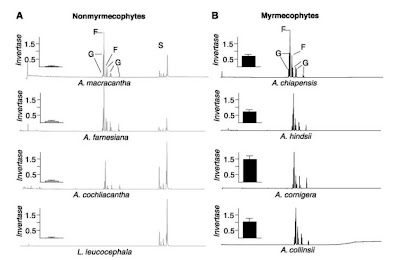
Another trait that has been proposed as relevant of the establishment of obligate plant-ant association correspond to the extrafloral nectar production. Inside the subgenus Acacia, both non-myrmecophyte and myrmecophyte plants release extrafloral nectar (see Figure 3). But the details of how this trait is expressed make the whole difference. In non specialized plants extrafloral nectar secretion respond positively to mechanical damage, herbivory or to the exogenous application of 1mM solution of the plant hormone jasmonic acid (also involve in other plant-herbivory chemical responses). By the other hand, in general, specialized myrmecophytes exhibit a constitutive (and comparatively slow) nectar release, irrespectively of whether exogenous stimuli applied. Thus the attraction of non-specialized nectar feeders (like unspecialized ants) seems to be related to the plant herbivory response machinery in non-myrmecophytes plants with EFN production, while on myrmecophytes this trait continuously expressed. Moreover, nectar composition on facultative EFN producers has three main sugars: glucose, fructose and sucrose, while myrmecophyte plants lacks sucrose (Figure 4).


Figure 4: Chromatograms of relative abundance of sugars in the EFN from non specialized (left) and myrmecophyte acacias (from Heil et al. 2005). Peaks identified as G; glucose, F: fructose, S: sucrose. Insert on left of graph is invertase activity in the nectar for each plant expresed as ug glucose released per ul of EFN per minute.

This is the result of post-secretory hydrolysis of the nectar sucrose on the obligate ant-interacting plant due to invertase activity. Sucrose and other di and trisaccharides are identified as a highly attractive sugars for many non-specialized ants. In nectar choice experiments using non specialized ants and myrmecophyte specialized ants it has been demonstrated that the addition of sucrose to the nectar of the derived myrmecophyte acacia, had triggered the attraction of non specialized ants, that previously (without sucrose) will not be attracted to the nectar of these plants but to the non-myrmecophyte ones. Contrarily, specialized ants are significantly attracted to nectar without sucrose. Analysis of digestive enzymes on these ants has repeatedly demonstrated the lower activity of invertases in extracts of the digestive systems of Pseoudomyrmex specialized ants, while the facultative plant interacting ants from the same genus, P. gracilis, showed greater invertase activity, this specie can actually live independently of acacia trees. Thus, this suggest that the obligate horizontally transmitted Acacia-Ant association is also supported by the transference of the hydrolysis process to the host plant in the evolution of this tight plant-insect association.


Cristian Villagra


PS: Follow the link to see a video of this fascinating interaction from the documental series The Secret Life of Plants.


References:

Agrawal AA. 1998. Leaf damage and associated cues induce aggressive ant recruitment in a neotropical ant-plant. Ecology 79: 2100–2112.

Heil M, Greiner S, Meimberg H, Krüger R, Noyer J-L, Heubl. G, Linsenmair KE, Boland W. 2004. Evolutionary change from induced to
constitutive expression of an indirect plant resistance. Nature 430: 205–208.

Heil M, Rattke J, Boland W. 2005. Post-secretory hydrolysis of nectar sucrose and specialization in ant/plant mutualism. Science 308:560–563.

Heil M. 2008 Indirect defence via tritrophic interactions. New Phytologist 178: 41–61.