Mostrando las entradas con la etiqueta comportamiento. Mostrar todas las entradas

domingo, marzo 22, 2009

Plant-Insect Horizontally Tranferred Interaction between Mirmecophyte Plants and Ants


Figure 1: hollow thorn Mesoamerican Acacia.

Following the idea of the proceses that allow inter-organims interactions to move from facultative to obligate, lets take a look at the amazing case of acacia trees and its Pseoudomyrmex ants asociates.

Among tropical plants, around 100 genera host specialized ant colonies in structures called “domatia” and in part of these cases, plants also provide these ants with food. Ants in this association exhibits intensive territorial and cleaning behavior over the plant. This has as a consequence the expulsion of other herbivores and their eggs, and the detachment of invasive vegetation and sometimes fungi as well. Thus this relationship has been described as mutualistic.

Extensive revision of this case has suggested that the trait making the interaction between myrmecophyte plants and ants obligatory is usually the formation of domatia (nesting structures) on the plant. Domatia usually are located on hollow stem and shoots, hollow thorns (like in the Figure 1), in leaf pouches, petioles or even on fruits. Additionally, some myrmecophytes present plant derived food rewards like food bodies and extrafloral nectar (EFN) (See Figure 2).


Figure 2: Extrafloral nectar producing structures (upper) and food bodies on acacia tree, visited by Pseoudomyrmex ants.

However, despite these plants and ants seems to be vitally dependent on such interaction, the mutualistic association, even for the ones considered obligate, is transferred horizontally: both partners reproduce independently and the association has to be established di novo in each subsequent generation.


Figure 3: Phylogenetic reconstruction of section from Acacia subgenus includying facultative (grey) and obligate ant interacting plants (orange), based on combined data matrix of chloroplast DNA markers, AFLP cluster analysis (from Heil et al. 2004).

Another trait that has been proposed as relevant of the establishment of obligate plant-ant association correspond to the extrafloral nectar production. Inside the subgenus Acacia, both non-myrmecophyte and myrmecophyte plants release extrafloral nectar (see Figure 3). But the details of how this trait is expressed make the whole difference. In non specialized plants extrafloral nectar secretion respond positively to mechanical damage, herbivory or to the exogenous application of 1mM solution of the plant hormone jasmonic acid (also involve in other plant-herbivory chemical responses). By the other hand, in general, specialized myrmecophytes exhibit a constitutive (and comparatively slow) nectar release, irrespectively of whether exogenous stimuli applied. Thus the attraction of non-specialized nectar feeders (like unspecialized ants) seems to be related to the plant herbivory response machinery in non-myrmecophytes plants with EFN production, while on myrmecophytes this trait continuously expressed. Moreover, nectar composition on facultative EFN producers has three main sugars: glucose, fructose and sucrose, while myrmecophyte plants lacks sucrose (Figure 4).
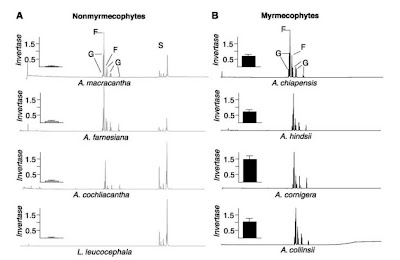


Figure 4: Chromatograms of relative abundance of sugars in the EFN from non specialized (left) and myrmecophyte acacias (from Heil et al. 2005). Peaks identified as G; glucose, F: fructose, S: sucrose. Insert on left of graph is invertase activity in the nectar for each plant expresed as ug glucose released per ul of EFN per minute.

This is the result of post-secretory hydrolysis of the nectar sucrose on the obligate ant-interacting plant due to invertase activity. Sucrose and other di and trisaccharides are identified as a highly attractive sugars for many non-specialized ants. In nectar choice experiments using non specialized ants and myrmecophyte specialized ants it has been demonstrated that the addition of sucrose to the nectar of the derived myrmecophyte acacia, had triggered the attraction of non specialized ants, that previously (without sucrose) will not be attracted to the nectar of these plants but to the non-myrmecophyte ones. Contrarily, specialized ants are significantly attracted to nectar without sucrose. Analysis of digestive enzymes on these ants has repeatedly demonstrated the lower activity of invertases in extracts of the digestive systems of Pseoudomyrmex specialized ants, while the facultative plant interacting ants from the same genus, P. gracilis, showed greater invertase activity, this specie can actually live independently of acacia trees. Thus, this suggest that the obligate horizontally transmitted Acacia-Ant association is also supported by the transference of the hydrolysis process to the host plant in the evolution of this tight plant-insect association.


Cristian Villagra


PS: Follow the link to see a video of this fascinating interaction from the documental series The Secret Life of Plants.


References:

Agrawal AA. 1998. Leaf damage and associated cues induce aggressive ant recruitment in a neotropical ant-plant. Ecology 79: 2100–2112.

Heil M, Greiner S, Meimberg H, Krüger R, Noyer J-L, Heubl. G, Linsenmair KE, Boland W. 2004. Evolutionary change from induced to
constitutive expression of an indirect plant resistance. Nature 430: 205–208.

Heil M, Rattke J, Boland W. 2005. Post-secretory hydrolysis of nectar sucrose and specialization in ant/plant mutualism. Science 308:560–563.

Heil M. 2008 Indirect defence via tritrophic interactions. New Phytologist 178: 41–61.


domingo, julio 27, 2008

Phyloepigenetics IV: Lagartija y nemátodo

Herrel et al 2008. Rapid large-scale evolutionary divergence in morphology and performance associated with exploitation of a different dietary resource. Proc Natl Acad Sci U S A. Mar 25;105(12):4792-5.

Excerpts!

"In 1971 five adult pairs of this species were moved from the small islet of Pod Kopiste (0.09 km2) to the nearby Pod Mrcaru (0.03 km2) by Nevo and coworkers (...). Although the islet of Pod Mrcaru was originally inhabited by another lacertid lizard species (Podarcis melisellensis), repeated visits (twice yearly over the past three years, beginning in 2004) show that this species has become extinct on Pod Mrcaru. Genetic mitochondrial DNA analyses indicate that the lizards currently on Pod Mrcaru are indeed P. sicula and are genetically indistinguishable from lizards from the source population"


"Differences in head size and shape also translate into significant dif ferences in bite force bet ween populations. Our data show that P. sicula lizards consume more plant material on Pod Mrcaru compared with the ancestral population on Pod Kopiste"


"This shift to a predominantly plant-based diet has resulted in the dramatic evolution of intestinal morpholog y. Morphological analysis of preserved specimens shows the presence of cecal valves (Fig. 4) in all individuals, including a hatchling (26.4-mm snout-vent length, umbilical scar present) and a very young juvenile (33.11-mm snout-vent length) examined from Pod Mrcaru."


"The fact that 1% of all currently known species of squamates have cecal valves (13, 14) illustrates the unusual nature of these structures in this population"

"Cecal valves slow down food passage and provide for fermenting chambers, allowing commensal microorganisms to convert cellulose to volatile fatt y acids (15, 16). Indeed, in the lizards f rom Pod Mrcaru, nematodes were common in the hindgut but absent from individuals f rom PodKopiste"

"Because of the larger food base available and the increase in the predict abilit y of the food source, lizard densities on Pod Mrcaru are much greater (..) lizards on Pod Mrcaru do no longer appear to defend territories. Moreover, changes in foraging style (browsing versus active pursuit of mobile prey) and social structure may also have resulted in the dramatic changes in limb proportions and maximal sprint speed previously documented for this population"

"Although the presence of cecal valves and large heads in hatchlings and juveniles suggests a genetic basis for these differences, further studies investigating the potential role of phenotypic plasticity and/or maternal effects in the divergence bet ween populations are needed"

Herrell no discute mucho qué tan relevante puede ser la simbiosis con un nemátodo. Veamos un ejemplo de anfibios


Effects of the nematode Gyrinicola batrachiensis on development, gut morphology, and fermentation in bullfrog tadpoles (Rana catesbeiana): a novel mutualism


Gregory S. Pryor *, Karen A. Bjorndal J. Exp. Zool. 303A:704-712, 2005.


Abstract

We describe a novel mutualism between bullfrog tadpoles (Rana catesbeiana) and a tadpole-specific gastrointestinal nematode (Gyrinicola batrachiensis). Groups of tadpoles were inoculated with viable or nonviable nematode eggs, and development, morphology, and gut fermentation activity were compared between nematode-infected and uninfected tadpoles. Nematode infection accelerated tadpole development; the mean time to metamorphosis was 16 d shorter and the range of times to metamorphosis was narrower in nematode-infected tadpoles than in uninfected tadpoles. At metamorphosis, infected and uninfected bullfrogs did not differ in body size or condition. Colon width, wet mass of colon contents, and concentrations of most fermentation byproducts (short-chain fatty acids: SCFAs) in the hindgut were greater in infected tadpoles. Furthermore, in vitro fermentation yields for all SCFAs combined were over twice as high in infected tadpoles than in uninfected tadpoles. One explanation for accelerated development in infected tadpoles is the altered hindgut fermentation associated with the nematodes. Energetic contributions of fermentation were estimated to be 20% and 9% of the total daily energy requirement for infected and uninfected tadpoles, respectively. Infection by G. batrachiensis nematodes potentially confers major ecological and evolutionary advantages to R. catesbeiana tadpoles. The mutualism between these species broadens our understanding of the taxonomic diversity and physiological contributions of fermentative gut symbionts and suggests that nematodes inhabiting the gut regions of other ectothermic herbivores might have beneficial effects in those hosts.


Si bien algunos nemátodos son parásitos en reptiles, otros no lo son:


Oecologia. 2006 Dec;150(3):355-61. Epub 2006

O'Grady SP, Dearing MD. Isotopic insight into host-endosymbiont relationships in Liolaemid lizards

Nitrogen isotopes have been widely used to investigate trophic levels in ecological systems. Isotopic enrichment of 2-5 per thousand occurs with trophic level increases in food webs. Host-parasite relationships deviate from traditional food webs in that parasites are minimally enriched relative to their hosts. Although this host-parasite enrichment pattern has been shown in multiple systems, few studies have used isotopic relationships to examine other potential symbioses. We examined the relationship between two gut-nematodes and their lizard hosts. One species, Physaloptera retusa, is a documented parasite in the stomach, whereas the relationship of the other species, Parapharyngodon riojensis (pinworms), to the host is putatively commensalistic or mutualistic. Based on the established trophic enrichments, we predicted that, relative to host tissue, parasitic nematodes would be minimally enriched (0-1 per thousand), whereas pinworms, either as commensals or mutualists, would be significantly enriched by 2-5 per thousand. We measured the (15)N values of food, digesta, gut tissue, and nematodes of eight lizard species in the family Liolaemidae. Parasitic worms were enriched 1+/-0.2 per thousand relative to host tissue, while the average enrichment value for pinworms relative to gut tissue was 6.7+/-0.2 per thousand. The results support previous findings that isotopic fractionation in a host-parasite system is lower than traditional food webs. Additionally, the larger enrichment of pinworms relative to known parasites suggests that they are not parasitic and may be several trophic levels beyond the host.


Correlating diet and digestive tract specialization: Examples from the lizard family Liolaemidae

Shannon P. O’Gradya, Mariana Morandob, Luciano Avilab and M. Denise Dearinga
Zoology 2005, 108 : 201-210

Abstract

A range of digestive tract specializations were compared among dietary categories in the family Liolaemidae to test the hypothesis that herbivores require greater gut complexity to process plant matter. Additionally, the hypothesis that herbivory favors the evolution of larger body size was tested. Lastly, the association between diet and hindgut nematodes was explored. Herbivorous liolaemids were larger relative to omnivorous and insectivorous congeners and consequently had larger guts. In addition, small intestine length of herbivorous liolaemids was disproportionately longer than that of congeners. Significant interaction effects between diet and body size among organ dimensions indicate that increases in organ size occur to a greater extent in herbivores than other diet categories. For species with plant matter in their guts, there was a significant positive correlation between the percentage of plant matter consumed and small intestine length. Herbivorous liolaemids examined in this study lacked the gross morphological specializations (cecum and colonic valves) found in herbivores in the families Iguanidae and Agamidae. A significantly greater percentage of herbivorous species had nematodes in their gut. Of the species with nematodes, over 95% of herbivores had nematodes only in the hindgut. Prevalence of nematodes in the hindgut of herbivores was 2× that of omnivores and 4× that of insectivores.


Los dichosos nemátodos se encuentran en todas las especies de reptil que tienen válvulas cecales


Preguntas:


Todo este cambio, en sólo 34 años.... es acaso una acumulación por selección direccional de varios genes? Grano fino, o grano grueso?

Cuánto de este cambios fenotípico drástico se debe más bien al efecto inmediato de diferentes condiciones epigenéticas, como la mentada asociación con el nemátodo?

jueves, julio 10, 2008

¿Búfalo o Buey?

Plasticity in the use of novel environments: Direct Internalization and Secondary isolation mechanisms.


Bufallo bull at Jackson Hole, WY, 2008


A premise of Natural Selection (NS) is that an organism can not avoid environmental pressures and, utterly succumb or succeed under nature’s phenotypic filter. As a consequence, those exaptative phenotypes that survive the filter will be conserved in evolutionary time, meanwhile others are eliminated. 

This selective operation has worked very well for centuries in the history of the relationship of humans and domesticated animals. The breeder can select the phenotypes that she/he wants, and eliminate the others. However, this operation may not apply as an historic explanation for life’s properties and diversity. 
Among several factors that may complicate the selective scenario, lets take a look at the use of novel habitats as a way for an organism to escape its elimination under selective pressures. 
Here I will review the role of phenotypic plasticity and learning, inner properties of organism, in accommodating organism ontogenetic niche for the use of novel habitats. The role of learning as a source of novelty had been largely discussed starting with Balwin’s seminal paper in 1886. Examples of plastic changes in the use of novel habitat or under habitat changes can be found in almost all the living groups. Interestingly, in some of these cases, the plastic changes not only help the organism to withstand NS, but also help to expand their niches and diversify. 
This natural drift can be originated, among other factors, by the direct internalization of novel habitat pressures on the inheritance system of the organism. For example by epigenetic processes, like DNA methylation induced by diet or stress. Other sources of internalization may include mutation induced under stress, like transposable elements activity or DNA polymerase activity among others. Under other category of internalization we can consider all kinds of symbiogenesis, described by DeBary in 1873, as the generation of “individuality by incorporation”. The use of a new host by a parasitic organism, cohabitation, or other kind of long-term living association, results in symbiogenesis: the appearance of new bodies, new organs, and new species. 
Alternatively the diversification in novel habitats can be a consequence of phenotypic canalization of the ontogenetic niche. Under this alternative, plastic changes related with the use of the novel habitat contribute to the sympatric or parapatric isolation of the organism experiencing it, and secondarily, these isolation mechanisms would affect inheritance processes. Evidences of this kid of processes can be found in many orders, many cases of these have been discussed in Nucleo Decenio.
Thus, under the pressures of a phenotypic filter like natural selection, the organism had at least some alternatives beside to be just eliminated, thanks to plasticity and the use of novel environment, leading a change in its ontogenetic niche.
The selective reductionism framework of the “Modern Synthesis” has been proven to be an incomplete picture for understanding evolution. An actualized view of evolutionary biology has to include in first place a theory of the organism, considering its properties as protagonist of its own ontogenetic and phylogenetic change. 

“..Although Charles Darwin’s theory of evolution laid the foundations of modern biology, it did not tell the whole story. Most remarkably, The Origin of Species said very little about, of all things, the origins of species. Darwin and his modern successors have shown very convincingly how inherited variations are naturally selected, but they leave unanswered how variant organisms come to be in the first place..”
Lynn Margulis, 1998.


     Cristian Villagra


References:

Agrawal AA. (2001) Phenotypic Plasticity in the Interaction and Evolution of Species. Science, 294.

Beltman JB., P Haccou & CT Cate (2004) Learning and Colonization of New Niches, A first step towards speciation. Evolution, 58, pp. 35–46.

Donohue K. (2004) Niche construction through phenological plasticity: life history dynamics and ecological consequences. New Phytologist. Vol 166: 83-92.

Dre`s M & Mallet J (2002) Host races in plant-feeding insects and their importance in sympatric speciation. Phil. Trans. R. Soc. Lond. B. 357, 471–492.

Hegrenes S. (2001) Diet-induced phenotypic plasticity of feeding morphology in the orangespotted sunfish, Lepomis humilis. Ecology of Freshwater Fish.10: 35–42.

Jablonka E. & Lamb’ M. J. (1998) Epigenetic inheritance in evolution. J. evol. biol. 11 159-183.

Lozada-Chávez I, Janga S.Ch. & Collado-Vides J. (2006) Bacterial regulatory networks are extremely flexible in evolution. Nucleic Acids Research 2006 34(12):3434-3445.

Margulis L. (1998) Symbiotic Planet: A New Look at Evolution. Basic Books, 147pp.

Maturana-Romesin H & Mpodozis J (2000) The origin of species by means of natural drift. Rev. chil. hist. nat. v.73 n.2.

Stamps J. (2003) Behavioural processes affecting development: Tinbergen’s fourth
question comes of age. Behaviour. 66:1-13.

Trussell GC (2000) Phenotypic Clines, Plasticity, and Morphological Trade-offs in an intertidial Snail. Evolution, 54: 151–166.


miércoles, mayo 28, 2008

Parental Care Usurpation as a model for thinking about Developmental Systems

Parental Care usurpators exploit the social behavior of their hosts, this “modo de vida,” it is present in numerous taxa and involve the partial sequestration of the ontogenetic niche of the host species. In this commentary I will mention two cases of parental care usurpation: the avian brood parasites (e.g. cuckoos) and the ant nest usurpations (often called slave-maker ants or pirate ants).
Due to the very emergent properties involved in the evolution of these life styles; these cases are interesting models for thinking about the value of Developmental System Theory or Evolution by Means of Natural Drift as explanatory backgrounds.

Previously in this blog, we have seen comments about the relevance of the “incomplete isolation” of the multicellulars systems processes as a way to understand certain kinds of dynamic changes in the ontogenetic niche. This “epigenetic permeability”, could be suggested as a property that may help to understand why it is not always necessarily an “Internalization” (i.e incorporation of adaptative traits in the genome of the evolving species) for the development of new life styles or lineage changes in order to get an idea of the points when this “epigenetic permeability” may help to explain the establishment and conservation of these life styles, lets compare the steps of the parasite-host interactions.

In avian brood parasites, the female lays the egg in the host nest, which has been recognized by some authors as the only interaction between the parasite and host species. I would suggest to add a second step that is performed by the parasite chick: the expulsion from the nest of the host offspring (this does not always happen though). For the realization of step one of the interaction, the parasite mother had to find the appropriate host nest and the host parents have to be fooled to keep believing that the extra egg belongs to them. Some parasites species present similar egg pigmentation with their main host, but it is not clear, as far as I´ve read, that this is genetically determined and that this trait can vary inter and intraspecies. The second step is very similar to other kind of parasitic interaction where the allocation of resources is diverted to feed the growing parasite (See Sacculina barnacles post in this blog as an example).
In ant nest usurpation species, the first step involves the usurpation of the queen host throne by the parasite ant. The female searching for nest, sneaking in the nest without being detected as alien by the colony, and (as similar as the avian parasite chick) the diversion towards the reproducing parasite.
In the second step, the parasite queen offspring will search for new host colonies, raid them and kidnap host worker’s larvae. Experiments have demonstrated that when two alternative host are available for the queen and she picks one of them in the first step, the parasite sons will also choose that one for collecting more workers.

This two examples suggest to me that the Developmental System is more than the niche variables and the inheritable organism material, and cannot be reduced to the somatic and germinal part as a satisfactory explanatory background but also the construction of these parasitic life styles due to epigenetic permeability are possible thanks to crucial behavioral operations (“conducta” in Maturana’s approach) that allow the emergence of these very externalized and dependent systems.


Cristian Villagra

sábado, marzo 29, 2008

Ecomorfología: la estructura supeditada al fenotipo ontogénico.

La ecomorfología hace referencia a la relación entre la morfología de los organismos y el rol ecológico, o modo de vida, que estos experimentan.
A diferencia de la morfología functional, que puede estudiarse en laboratorio, o en el registro fósil, sin necesidad de conocer el contexto natural en el que se desenvuelve el organismo, ya que se centra en la relación entre la estructura y función de un rasgo en particular, la ecomorfología es una aproximación centrada en todos los aspectos del fenotipo, no en algunos rasgos en particular y se sirve de la morfología funcional dándole un contexto biológico.
Por ejemplo la convergencia ocular, i.e., la orientación frontalizada de los ojos, se observa en una gran cantidad de linajes, como en aves nocturnas y/o cazadoras, como también en mamíferos como los carnívoros (placentados y marsupiales) o primates. En alguna medida en roedores nocturnos también se observa un grado de convergencia ocular mayor que en sus linajes hermanos de actividad diurna (tesis de Tomás Vega).
Cristopher Heesy (2008) analizó cráneos de un gran número (321) de taxa de mamíferos actuales y correlacionó el grado de convergencia con diversos aspectos del modo de vida. Evaluó cuales aspectos del fenotipo ontogénico, como el patrón de actividad (diurno/nocturno), la preferencia de sustrato (aéreo/arborícola/terrestre) y el grado de faunivoría guardaban relación con el grado de convergencia.Fig 1. Campo visual de la ardilla (a,b) y del lémur (c,d). Tomado de Hessy 2008.

Linajes nocturnos y crepusculares (tanto marsupiales como placentados) mostraron mayor convergencia ocular que los diurnos. Los placentados carnívoros (tanto diurnos como nocturnos) mostraron mayor convergencia que los forrajeros oportunistas o no-carnívoros. Sin embargo, no encontraron asociación entre convergencia y la preferencia de sustrato. Tales resultados son consistentes con el hecho de que la visión binocular permite detectar profundidad (la estereópsis es buena para los depredadores) y aumenta la agudeza visual (nocturnos), mientras que un mayor campo visual, en desmedro de la binocularidad, permite detectar al depredador en espacios abiertos como las praderas.

Una predicción importante de la filoepigénesis: Similitud en ecomorfologías implican una similitud en los fenotipos ontogénicos.

Por ejemplo en distintos linajes de mamíferos se pueden reconocer varias ecomorfologías, como forma de hormiguero, cola prensil, ojos frontalizados, etc. Lo más iluminador es que en cada linaje uno puede reconocer casi todos los modos de vida asi como sus especializaciones morfológicas.


Fig 2. Distintos ecomorfotipos ocurren en cada linaje.

De hecho, esto fue la causa de que la filogenia de mamíferos fuera un caos mientras se consideraban rasgos morfológicos en las reconstrucciones: todos los linajes tenian todos los ecomorfotipos, por lo que no fue hasta el advenimiento de reconstrucciones basadas en eventos moleculares raros que se pudo tener un esquema más claro de la filogenia de mamiferos existentes (ver Springer et al 2004).

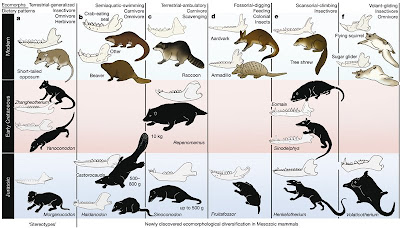
Lo más bello de todo es que esta ubicuidad de modos de vida y morfos similares también ha ocurrido en tiempos remotos, a modo de experimentos evolutivos en linajes ancestrales de igual manera que en linajes actuales, como la siguiente figura aparecida en el paper de Zhe-Xi Luo (2007), el cual es tan iluminador que merecería su post propio.


Fig 3. Experimentos evolutivos de mamíferos del Mesozoico y su convergencia ecológica con ecomorfotipos de mamíferos modernos. Ecomorfos: a) terrestre insectivoro/omnivoro, b) Carnivoro/omnivoro semiacuático, c) carnivoro oportunista/terrestre, d) fosorial, cavador/hormiguero, e) trepador/insectívoro, f) planeador/omnívoro. En celeste: Jurásico, rosa: Cretásico temprano, blanco: actual.

Abrazos,

Rodrigo Suárez.


Wainwright PC (1991) Ecomorphology: Experimental Functional Anatomy for Ecological Problems. American Zoologist; 31(4):680-693

Bock WJ (1994) Concepts and methods in ecomorphology. J. Biosci.; 19(4):403-413.

Hessy CP (2008) Ecomorphology of orbit orientation and the adaptive significance of binocular vision in primates and other mammals. Brain Behav Evol;71(1):54-67.

Luo ZX (2007) Transformation and diversification in early mammal evolution. Nature;450(7172):1011-9

sábado, marzo 22, 2008

Whereupon Lewontin is criticized, and "Phyloepigenetics" is born

In "The triple helix" Lewontin seems to contradict himself a bit on the importance of genes. Consider this paragraph:

"Of course it is true that lions look different from lambs and chimps and humans because they have different genes, and a satisfactory explanation for the differences between lions, lambs, chimps and us need not involve other causal factors"
(Italics are mine)

Since Lewontin in his next breath talks quite a bit about the importance of environment and random noise in development, we are forced to wonder why they would not count as causal factors when it comes to explaining inter-species differences.

I suspect this is the result of a typically neodarwinian mistake born from the circular logic of their definition of evolution. Because "evolution is genetic change of populations", when observing a difference that is species-level (evolutionary) they get confused and think they can assume that difference to be the result of natural selection for genetic mutations (unless it is a very obviously a non-adaptive difference, in which case it is still genetic mutations, and drift rather than selection) . This argument in fact is repeatedly encountered in the discussion over whether human "intelligence genes" exist or not. "Evolutionary" psychologists (ultradarwinians) argue that the fact the human brain has evolved from smaller, less-smart brains like those of other apes implies natural selection for "intelligence genes" must have occurred in the human line, and thus that genes capable of increasing fitness through intelligence must indeed exist (The fact being that their effects are difficult to detect. Only using lots of data, statistical correlations for only very small increases in IQ scores is all that is ever detected for an alleged "intelligence gene)"

This argument, that seems so impeccable to those accustomed to thinking with a neodarwinian cap, can be exposed for the misleading definition-game it is when we stop to analize a few case-studies. The human trait of bipedism for instance. Below is the photograph of one of two "wolf girls", Amala and kamala, that were raised by wolves in India and then "rescued" into civilization in the 1920's. Extensive written and photographic documentation were produced by the priest who took care of them. As you can see in the photograph, the girls used quadrupedal, rather than bipedal, locomotion. The priest tried hard but made little progress training them into walking like people. They did not speak and and had obviously subnormal cognitive capacities for human standards .


You would think that genetic influences over general human anatomical structure would be sufficient to lead to bipedality. However, let us remember that in our ontogeny we do, in fact, learn to walk bipedally. This important difference between humans and other animals seems to not come about without an appropiate context, provided by interactions among humans, which are in fact required for preserving the behavior of bipedal walking .

Let's talk about symbolic language, another difference between humans and other species. Beyond Amala and Kamala, it is clear from numerous documented cases of feral or cruel upbringing of children, that children deprived from human interaction will not learn to speak and will develop a severely subnormal intelligence. But perhaps more interesting is the reverse experiment, that is, not only is it possible that a human may not learn to speak despite of any "language genes", but also, it is a fact that non-human primates can learn sign language and use it to communicate, despite any lack of "language genes". In this case, an important part of that species difference has been phenocopied in the other species, once again, with the aid of an adequate environmental context.

So, there definitely is an epigenetic component to the explanation of cross-species differences. A purely genetic causation could never be a satisfactory explanation. We will find that, as we compare the terminal taxa of a phylogentic tree, we will be able to see nodes in which clearly different epigenetic conditions have become established and can be directly responsible for great phenotypic differences or epigenetic apomorphies ; the sublime confirmation of everything is, of course, the experimental phenocopy or reversal through alteration of the suspect epigenetic factor.

I can think of several confirmed examples from non-human organisms and simple phenotypic traits, as well as several epigenetic hypotheses that have never been discussed before as explanations of differences between species, perhaps for lack of a more formal approach. I thus propose we begin by calling this approach Phyloepigenetics.

The intention of this post is to start several posts where we will be studying and discussing probable cases of epigenetic differences at the species-level, and thus make ourselves with a litte more "cultural baggage" to defend this new approach. I invite everyone to share examples!! I will soon be posting one about ...dinosaurs! Phyloepigenetics can be paleo, too.

Reference:
Lewontin, R. 2000 The triple Helix: Gene, Organism and Environment. Harvard University Press.

jueves, febrero 21, 2008

Horrid Phenotypic integration!


Since past centuries naturalist, Cirripedes (or barnacles) have been studied because their peculiar morphology and life cycle. They live in a calcareous shell like a mollusk as adults, and they have articulated biramous appendages like crustaceans. Thanks to the study of its development, through nauplius larva, it was possible to classify them as crustaceans. Whereas, they have an incomplete abdomen, lacking terminal segments present in other crustaceans.

Fig 1: Cirripedes drawn by Haeckel in his beautiful bool Kunstformen der Natur 1904. A parasitized crab by Sacculina sp. can bee seen in the center of the picture.


One of the strangest groups of cirripedes are the Rhizocephalan barnacles which are sessile adult parasites of other crustaceans with free-swimming larvae (Fig 1 and 2). Their mature females (called externa) are situated in the abdominal brood chamber of the host, lack even the rudiments of an alimentary canal and have neither excretory nor respiratory organs. But it penetrates it's hosts with a nutrient-absorbing system of rootlets, which possibley links the parasite to these functions in the host (Fig 2 ).

Fig 2: Peltogaster (Peltogastridae) whole externa and root system attached to a part of the main abdominal root trunk From Bresciani & Hoeg 2001.
The life cycle (Fig 3) of the parasite involves a mature female externa which is fertilized by one or two cryptic dwarf males and which subsequently releases a series of broods of free swimming nauplii. The nauplii develop lecithotrophically, metamorphose into cypris larvae after about 5–6 days and become competent to settle after another 3–4 days in the plankton. Female cypris larvae must locate a suitable host while the male cypris larvae must find a parasitized host containing a virgin female. Some of the sensory structures involved in this behavior are the lattice organs and the aesthetasc setae found on antennules of the cyprids that have been proposed as olfactory organs. Females possess one and the males two. It had been demonstrated that larvae can use waterborne host metabolites to find a suitable host.


Fig 3: Generic life cycle of Cirripedian parasite, from Øksnebjerg 1999.


Female cyprids settle on the exoskeleton of a host crab at the base of a plumose seta and metamorphose into a special stage known as the kentrogon. The kentrogon penetrates the exoskeleton of the crab with a hollow stylet and injects the primordial parasite into the hemocoelic fluid. After an internal phase of a few months to 3 years, the parasite produces an external virginal reproductive body (externa) situated under the abdomen of the host. The externa attracts male cyprids, which implant as dwarf males and remain with the female externa for the duration of the latter’s lifetime and fertilize all its broods. Externa failing to receive at least one male cannot mature and eventually perish, leaving a scar on the host exoskeleton.


Fig 4: First photo shows the cyprid larva, antennae are marked with arrows, from Pasternak et al 2005. Second photo shows the kentrogon stage injecting cells in to the host body, from Hoeg 1987.

Sacculina carcini is a rhizocephalan parasite that attacks the crab C. maenas. S. carcini can have on their hosts severe and lasting effects on these include growth, morphology, physiology, and behavior of the host crab. The parasite can arrest the moult cycle of its host crab (which therefore suffers increased fouling). As a consequence of rootlet growth this parasite castrates both male and female hosts and phenotypically feminizes the males. Both sexes suffer alterations in behavior such as response to the externa and Sacculina eggs as their own brood. For example a common behavior of fecunded female crabs is to climb to some high rock and groom its abdomen to release the fertilized eggs from the brood pouch. Moving her claw the mother crab stir the water generating a flow. In the same way male parasitized by Sacculina will display a similiar behavior when the parasite offpring is ready to hatch, he will groom the Externa and release the next generation of his foster sons. “Sacculinized” host became an integrated developmental system that include the castrated crab, the breeding externa and the dwarf males. These creatures had been the focus of interesting cromosome and molecular studies that we can discuss in a next episode.

Fig 5: Rhizocephalan Extena on infected host species showing rootlets distribution in different parasite-host systems: A: Peltogaster paguri (Peltogastridae) on Pagurus bernhardus. B: Sacculina carcini (Sacculinidae) on Carcinus maenas. C: Sylon hippolytes (Clistosaccidae) on Spirontocaris lilljeborgi, from Bresciani & Hoeg 2001.


Cristian Villagra


References:

Bresciani J & Høeg JT (2001) Comparative Ultrastructure of the Root System in Rhizocephalan Barnacles (Crustacea: Cirripedia: Rhizocephala). Journal of Morphology, 249:9–42.

Herberts C (1982) Host-Parasite Relation between the Shore Crab Carcinus maenas and Sacculina carcini (Rhizocephala): Identification and Characterization of a Specific Fraction Correlated with Parasitism. Journal of Invertebrate Pathology, 39, 60-65.

Hoeg JT (1987) The relation between cypris ultrastructure and metamorphosis
in male and female Sacculina carcini (Crustacea, Cirripedia). Zoomorphology, 107:299-311.


Le Mouchel-Vielh E, Rigolot C, Gibert J-M & Deutsch JS (1998) Molecules and the Body Plan: The Hox Genesof Cirripedes (Crustacea). Molecular Phylogenetics and Evolution, 9,382–389.

Øksnebjerg B (1999) The Rhizocephala (Crustacea: Cirripedia) of the Mediterranean and black seas: taxonomy, biogeography and ecology. Israel Journal of Zoology, 46: 1-102.

Pasternak Z, Garm A & Høeg JT (2005) The morphology of the chemosensory aesthetasc-like setae used during settlement of cypris larvae in the parasitic barnacle Sacculina carcini (Cirripedia: Rhizocephala). Marine Biology, 146: 1005–1013.


Threshera RE, Wernerb M, Høegc JT, Svaned I, Glennerc H, Murphy NE, Wittwer C (2000) Developing the options for managing marine pests: specificity trials on the parasitic castrator, Sacculina carcini, against the European crab, Carcinus maenas, and relatedspecies. Journal of Experimental Marine Biology and Ecology, 254: 37–51


Strathmann RR (1993) Hypotheses on the Origins of Marine Larvae
. Annual Review of Ecology and Systematics, 24: 89-117. Walker G(1985) The cypris larvaea of sacculina carcini Thompson (Crustacea: Cirripedia: Rhizocephala) J. Eq. Mar. hoI. Ecof, 93:131-145.


jueves, enero 17, 2008

Hipótesis: Evolución de la Epitoquía


En la figura de arriba se aprecian dos formas de epitoquía distintas que pueden darse, por ejemplo,  en distintas especies del género Autotylus.  Como ya se mencionó, uno de ellos conlleva la yemación o "estolonización" de individuos epitoquiales; en la otra forma, no hay nuevos individuos, sino que es el mismo individuo el que se transforma en un epitoco, el cual es prácticamente indistinguible del epitoco resultate de la estolonización en otras especies cercanas. Pese a mi infinita ignorancia, me atrevo a formular la hipótesis siguiente:

1) Uno de las dos modos probablemente es derivado del otro.  Permítaseme sugerir que la epitoquía por epigamia precedió a la epitoquía por estolonización. En todo momento el gusano guarda el potencial para producir otro individuo del mismo fenotipo (atoquial) asexualmente, por yemación. 

2) El fenotipo epitoquial me parece similar a los fenotipos en respuesta a stress que pueden verse asociados a especies en que la liberación de los gametos ocurre en un lugar especial, diferente al de la residencia habitual del organismo. 

Considérese un salmón en fase tardía; tiene un  fenotipo  bastante modificado, se ha sometido a un gran stress, y este fenotipo se desarrolla en asociación con la liberación de los gametos en el río (su lugar de nacimiento). Nótese, eso sí, que en la epigamia el epitoco no muere sino que puede desdiferenciarse y reincorporarse a la vida "normal". La epigamia puede quizás considerarse entonces como  una versión "atenuada" del mortífero drama semélparo del salmón. Lo de morirse vendrá después, con la epitoquía por estolonización. 

3) Lo que ha ocurrido en la  epitoquía estolonización es que el fenotipo epitoquial se ha acoplado con el proceso de yemación asexual, tal que el nuevo individuo "nace estresado" y con fenotipo epitoquial. Es decir, se ha asimilado la respuesta de estrés, que va acoplada desde el comienzo al desarrollo de un nuevo individuo epitoquial; cabe destacar que este individuo epitoquial guarda una semejanza más completa con la historia del salmón; libera los gametos y luego muere. 

miércoles, enero 16, 2008

Epitoquía del alma mía (segunda parte -la venganza)


Lo prometido es deuda gracias a Mr. Sanders, acá les puedo dejar los dibujitos para que se fijen en la gran modificación de las sedas natatorias en el epitoco, Además puse el detalle del comportamiento del epitoco macho en donde le "realiza una danza" a la luz de la luna antes de ambos liberar los gametos.

Roberto

lunes, enero 14, 2008

Epitoquía del alma mía

Uno de los modos reproductivos más curiosos es la epitoquía, que ocurre en varios anélidos poliquetos (marinos). Esta singular forma de reprodución parece derivarse de la capacidad vista en varios poliquetos de producir un nuevo individuo completo de manera asexual, por yemación (imagen a la derecha). En la epitoquía, en vez de producirse por yemación un nuevo individuo igual al progenitor, se produce desde los segmentos más posteriores la yemación de un individuo especializado, un "individuo epitoquial" incompleto, incapaz de comer o de sobrevivir, pero capaz de desprenderse del progenitor, de nadar, y de detectar la luz de la luna, desplazándose en la noche hacia la superficie donde ocurre la liberación de los gametos. 

Un caso bien conocido es el del gusano palolo (imagen a la izquierda), donde los nativos predicen la noche exacta en que ocurrirá la liberación de los epitoques y los gametos, haciéndose de un singular festín.
Es interesante contemplar este caso desde la perspectiva de linaje utilizada por M&M. La evolución de un fenotipo epitoquial puede con toda legitimidad describirse como la aparición de un nuevo linaje, de manera similar a cómo lo es el origen de una nueva casta o un nuevo tipo celular. En la repetición del fenómeno de la epitoquía, sabemos que debe haber exisitido un cambio, sea en la estructura resultante de la reproducción, o en las condiciones epigenéticas. En este punto es donde resulta interesante señalar a aún otro mode de epitoquía, en la que no ocurre la yemacion de nuevos individuos, sino que en realidad, lo que sucede es que el individuo completo es "epitoquizado", perdiendo el tubo digestivo, aumentando su actividad nadadora y su sensibilidad perceptual, y transformándose en un individuo epitoquial condenado a muerte que trasporta los gametos a su lugar de liberación. Este hecho es bastante interesante ya que nos muestra como el procso de especificación de un fenotipo de tipo epitoquial es una vía epigenética que puede ser desacoplada o acoplada a la reproducción de un individuo epitoquial independiente. Muuy interesante-¿no?

lunes, noviembre 12, 2007

Mono anfíbio


"And they appear to do this just for fun!" Hehehe

Como no caso da moréia, plasticidade e comportamento direcionando o viver.

sábado, julio 21, 2007

Confundiendo seleccion natural con seleccion de nicho


En este extenso estudio se muestra cómo en los cíclidos del lago victoria, los peces presentan distintos alelos de sus opsinas, que responden a diferentes longitudes de onda. En el lago existen distintos medios de luz a medida que nos desplazamos hacia el fondo. Lo que los autores han descubierto es que a una determinada profundidad el alelo más representado es aquel que tiene la absorvancia adecuada a la longitud de onda de la luz en ese nivel.

La conclusión de los autores del trabajo está en el título: selección natural divergente, hacia diferentes extremos de una gradiente ambiental. El estándar de la evidencia para este tipo de conclusiones hoy en día es sencillamente que se observe una relación entre una diferencia genética y una condición ambiental. Por ejemplo, también se ha argumentado selección natural para la correlación de alelos de ectodysplasina, con y sin armadura, y la vida en agua salada o agua dulce, de peces espinosos (Gasterosteus)

Sin embargo, es realmente un fenómeno de selección natural? Según un modelo de selección natural, esta distribución se explica porque cada alelo ha sido más "exitoso" en su respectivo nivel. Es decir, se ve un escenario en que todas las opsinas están originalmente presentes en cada nivel, pero por competencia y selección natural, se va imponiendo una de ellas.
Pero es realista este escenario? Más que competir en cada nivel, es mucho más probable que un pez se desplace conductualmente en la columna de agua, frecuentando los niveles en los que sus opsinas le permitan ver mejor. Es decir, lo que vemos es el resultado de cómo cada tipo de ser vivo selecciona su medio, de acuerdo a su estructura y conducta; no así que el medio selecciona al ser vivo. El resultado final es el mismo: La variacion genética se va segregando entre los distintos niveles del lago.
Sin embargo, Terai et al. nunca mencionan esta posibilidad, pese a que claramente puede explicarnos bastante sobre esta distribución de las opsinas...

-Sanders

jueves, julio 12, 2007

Adaptada ou simplemente era possível?

Depois do urso que andava de bicicleta, apresentamos a enguia que catava caranguejos!


Uma vez Mpodozis falou algo assim: "Tudo que hoje é obrigatório um dia foi facultativo"

jueves, abril 19, 2007

aonde la Biston


Así es. El famoso caso de la Biston, del melanismo industrial, está lejos de estar comprobado. Por ejemplo, las Biston no se posan sobre los troncos, sino en el follaje como se ve en la foto.
Vean el sitio de

Mike Majerus

Justo antes del listado de sus publicaciones hay un link para bajar un documento word con la información.

Es un tipo muy cauteloso en sus críticas... nos dice que el melanismo segrega mendelianamente "bajo condiciones uniformes controladas". Esto implica que habrían condiciones ambientales capaces de afectar el color. Pero eso, no lo trata explícitamente en ninguna parte.
Típicos pudores darwinistas.

-Sanders

domingo, abril 15, 2007

El Extraordinario Pato Quetru


Para ilustrar la continuidad de los procesos sistémicos de cambio onto-filogeneticos, podríamos sugerir el enigmático caso del Pato Quetru no Volador (Tachyeres pteneres) en comparación con el Pato Quetru Volador (Tachyeres patachonicus) ambos correspondientes a la Familia: Anatidae Subfamilia: Tadorninae.
Este interesante pato (conocido también como patovapor de Magallanes) se encuentra desde Chiloe al Cabo de Hornos y por Argentina de Chubut a Tierra del Fuego habitando costas rocosas y protegidas. Se alimentan de peces, moluscos y crustáceos que capturan buceado durante la marea alta (De la Peña & Rumboll, 1988). Esta ave tiene la peculiaridad de no volar y ser “sedentario”, lo que se ha atribuido a la longitud de sus alas y a su peso. Similar a esta especie pero más liviano y de alas y colas de mayor tamaño es el pato Quetru volador, que habita simpátricamente a su hermano no volador y tiene una dieta similar. Interesantemente además, este último puede habitar también lagos y lagunas interiores, regresando a la costa estacionalmente. Facultativamente, este pato puede quedarse viviendo en la costa frecuentando los mismos lugares del Quetru no-volador sin migrar a aguas interiores, en este caso se ha descrito que esta especie asimilaría el comportamiento del patovapor de no volar o en caso de emprender vuelo lo hace a último momento bajo este modo de vida, una tabla de comparaciones morfológicas y otros datos puede verse en la pagina web citada en las referencias.
Estudios de genética de poblaciones han encontrado diferencias entre estos patos, donde el pato volador es el mas distinto genéticamente de otra variedades relacionadas, mientras que el patro Quetru volador es mas cercano genéticamente a las especies T. brachypterus y T. leucocephalus (Corbin et al, 1988).
Por otro lado, no solamente es posible encontrar variabilidad genetica y conductual en la especie voladora, estudios de la variación geográfica de la morfología del esqueleto de estos patos coherentes con las reglas ecogeográficas de latitud, pero también presentarían tendencias localidad-especifica en la morfología ósea (Livezey, 1996).
Considerando que la morfología puede ser heredada tan indirectamente como los patrones de movimiento, este caso podría corresponder a un ejemplo de cómo la conducta, es decir la relación creativa del organismo con el medio a través de los modos de vida esta generando cambio evolutivo onto-filogenético. Se podría especular que el pato Quetru no volador es una variante derivada del volador, donde las condiciones de existencia del modo de vida sedentario coincidieron suficientemente como para que la conducta y la morfogia se constituyesen como un sistema heredable. Alternativamente estos patos son el resultado de mutaciones puntuales que a traves de micro y macro seleccion dieron como resultado estas maravillosas adaptaciones...etc etc etc...
Bueno, Pero para saber eso hay que ir al Sure a muestrear!
Diablete

REFERENCIAS:

Kendall W. Corbin, Bradley C. Livezey, Philip S. Humphrey (1988) Genetic Differentiation among Steamer-Ducks (Anatidae: Tachyeres): An Electrophoretic Analysis. The Condor, Vol. 90, pp. 773-781

De la Peña, MR & Rumboll, M (1988) Birds of Southern South America and Antartica.HarperCollins Ed, 304p.

Livezey, BC (1996) Geographic variation in skeletons of flying steamer-ducks (Anatide: Tachyeres patachonicus) Journal of Biogeography, 13, 511-525

y En la Red:
http://www.avesdechile.cl/