Mostrando las entradas con la etiqueta epigenetic permeability. Mostrar todas las entradas

domingo, marzo 22, 2009

Plant-Insect Horizontally Tranferred Interaction between Mirmecophyte Plants and Ants


Figure 1: hollow thorn Mesoamerican Acacia.

Following the idea of the proceses that allow inter-organims interactions to move from facultative to obligate, lets take a look at the amazing case of acacia trees and its Pseoudomyrmex ants asociates.

Among tropical plants, around 100 genera host specialized ant colonies in structures called “domatia” and in part of these cases, plants also provide these ants with food. Ants in this association exhibits intensive territorial and cleaning behavior over the plant. This has as a consequence the expulsion of other herbivores and their eggs, and the detachment of invasive vegetation and sometimes fungi as well. Thus this relationship has been described as mutualistic.

Extensive revision of this case has suggested that the trait making the interaction between myrmecophyte plants and ants obligatory is usually the formation of domatia (nesting structures) on the plant. Domatia usually are located on hollow stem and shoots, hollow thorns (like in the Figure 1), in leaf pouches, petioles or even on fruits. Additionally, some myrmecophytes present plant derived food rewards like food bodies and extrafloral nectar (EFN) (See Figure 2).


Figure 2: Extrafloral nectar producing structures (upper) and food bodies on acacia tree, visited by Pseoudomyrmex ants.

However, despite these plants and ants seems to be vitally dependent on such interaction, the mutualistic association, even for the ones considered obligate, is transferred horizontally: both partners reproduce independently and the association has to be established di novo in each subsequent generation.


Figure 3: Phylogenetic reconstruction of section from Acacia subgenus includying facultative (grey) and obligate ant interacting plants (orange), based on combined data matrix of chloroplast DNA markers, AFLP cluster analysis (from Heil et al. 2004).

Another trait that has been proposed as relevant of the establishment of obligate plant-ant association correspond to the extrafloral nectar production. Inside the subgenus Acacia, both non-myrmecophyte and myrmecophyte plants release extrafloral nectar (see Figure 3). But the details of how this trait is expressed make the whole difference. In non specialized plants extrafloral nectar secretion respond positively to mechanical damage, herbivory or to the exogenous application of 1mM solution of the plant hormone jasmonic acid (also involve in other plant-herbivory chemical responses). By the other hand, in general, specialized myrmecophytes exhibit a constitutive (and comparatively slow) nectar release, irrespectively of whether exogenous stimuli applied. Thus the attraction of non-specialized nectar feeders (like unspecialized ants) seems to be related to the plant herbivory response machinery in non-myrmecophytes plants with EFN production, while on myrmecophytes this trait continuously expressed. Moreover, nectar composition on facultative EFN producers has three main sugars: glucose, fructose and sucrose, while myrmecophyte plants lacks sucrose (Figure 4).
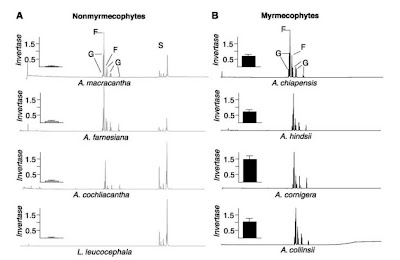


Figure 4: Chromatograms of relative abundance of sugars in the EFN from non specialized (left) and myrmecophyte acacias (from Heil et al. 2005). Peaks identified as G; glucose, F: fructose, S: sucrose. Insert on left of graph is invertase activity in the nectar for each plant expresed as ug glucose released per ul of EFN per minute.

This is the result of post-secretory hydrolysis of the nectar sucrose on the obligate ant-interacting plant due to invertase activity. Sucrose and other di and trisaccharides are identified as a highly attractive sugars for many non-specialized ants. In nectar choice experiments using non specialized ants and myrmecophyte specialized ants it has been demonstrated that the addition of sucrose to the nectar of the derived myrmecophyte acacia, had triggered the attraction of non specialized ants, that previously (without sucrose) will not be attracted to the nectar of these plants but to the non-myrmecophyte ones. Contrarily, specialized ants are significantly attracted to nectar without sucrose. Analysis of digestive enzymes on these ants has repeatedly demonstrated the lower activity of invertases in extracts of the digestive systems of Pseoudomyrmex specialized ants, while the facultative plant interacting ants from the same genus, P. gracilis, showed greater invertase activity, this specie can actually live independently of acacia trees. Thus, this suggest that the obligate horizontally transmitted Acacia-Ant association is also supported by the transference of the hydrolysis process to the host plant in the evolution of this tight plant-insect association.


Cristian Villagra


PS: Follow the link to see a video of this fascinating interaction from the documental series The Secret Life of Plants.


References:

Agrawal AA. 1998. Leaf damage and associated cues induce aggressive ant recruitment in a neotropical ant-plant. Ecology 79: 2100–2112.

Heil M, Greiner S, Meimberg H, Krüger R, Noyer J-L, Heubl. G, Linsenmair KE, Boland W. 2004. Evolutionary change from induced to
constitutive expression of an indirect plant resistance. Nature 430: 205–208.

Heil M, Rattke J, Boland W. 2005. Post-secretory hydrolysis of nectar sucrose and specialization in ant/plant mutualism. Science 308:560–563.

Heil M. 2008 Indirect defence via tritrophic interactions. New Phytologist 178: 41–61.


jueves, julio 10, 2008

¿Búfalo o Buey?

Plasticity in the use of novel environments: Direct Internalization and Secondary isolation mechanisms.


Bufallo bull at Jackson Hole, WY, 2008


A premise of Natural Selection (NS) is that an organism can not avoid environmental pressures and, utterly succumb or succeed under nature’s phenotypic filter. As a consequence, those exaptative phenotypes that survive the filter will be conserved in evolutionary time, meanwhile others are eliminated. 

This selective operation has worked very well for centuries in the history of the relationship of humans and domesticated animals. The breeder can select the phenotypes that she/he wants, and eliminate the others. However, this operation may not apply as an historic explanation for life’s properties and diversity. 
Among several factors that may complicate the selective scenario, lets take a look at the use of novel habitats as a way for an organism to escape its elimination under selective pressures. 
Here I will review the role of phenotypic plasticity and learning, inner properties of organism, in accommodating organism ontogenetic niche for the use of novel habitats. The role of learning as a source of novelty had been largely discussed starting with Balwin’s seminal paper in 1886. Examples of plastic changes in the use of novel habitat or under habitat changes can be found in almost all the living groups. Interestingly, in some of these cases, the plastic changes not only help the organism to withstand NS, but also help to expand their niches and diversify. 
This natural drift can be originated, among other factors, by the direct internalization of novel habitat pressures on the inheritance system of the organism. For example by epigenetic processes, like DNA methylation induced by diet or stress. Other sources of internalization may include mutation induced under stress, like transposable elements activity or DNA polymerase activity among others. Under other category of internalization we can consider all kinds of symbiogenesis, described by DeBary in 1873, as the generation of “individuality by incorporation”. The use of a new host by a parasitic organism, cohabitation, or other kind of long-term living association, results in symbiogenesis: the appearance of new bodies, new organs, and new species. 
Alternatively the diversification in novel habitats can be a consequence of phenotypic canalization of the ontogenetic niche. Under this alternative, plastic changes related with the use of the novel habitat contribute to the sympatric or parapatric isolation of the organism experiencing it, and secondarily, these isolation mechanisms would affect inheritance processes. Evidences of this kid of processes can be found in many orders, many cases of these have been discussed in Nucleo Decenio.
Thus, under the pressures of a phenotypic filter like natural selection, the organism had at least some alternatives beside to be just eliminated, thanks to plasticity and the use of novel environment, leading a change in its ontogenetic niche.
The selective reductionism framework of the “Modern Synthesis” has been proven to be an incomplete picture for understanding evolution. An actualized view of evolutionary biology has to include in first place a theory of the organism, considering its properties as protagonist of its own ontogenetic and phylogenetic change. 

“..Although Charles Darwin’s theory of evolution laid the foundations of modern biology, it did not tell the whole story. Most remarkably, The Origin of Species said very little about, of all things, the origins of species. Darwin and his modern successors have shown very convincingly how inherited variations are naturally selected, but they leave unanswered how variant organisms come to be in the first place..”
Lynn Margulis, 1998.


     Cristian Villagra


References:

Agrawal AA. (2001) Phenotypic Plasticity in the Interaction and Evolution of Species. Science, 294.

Beltman JB., P Haccou & CT Cate (2004) Learning and Colonization of New Niches, A first step towards speciation. Evolution, 58, pp. 35–46.

Donohue K. (2004) Niche construction through phenological plasticity: life history dynamics and ecological consequences. New Phytologist. Vol 166: 83-92.

Dre`s M & Mallet J (2002) Host races in plant-feeding insects and their importance in sympatric speciation. Phil. Trans. R. Soc. Lond. B. 357, 471–492.

Hegrenes S. (2001) Diet-induced phenotypic plasticity of feeding morphology in the orangespotted sunfish, Lepomis humilis. Ecology of Freshwater Fish.10: 35–42.

Jablonka E. & Lamb’ M. J. (1998) Epigenetic inheritance in evolution. J. evol. biol. 11 159-183.

Lozada-Chávez I, Janga S.Ch. & Collado-Vides J. (2006) Bacterial regulatory networks are extremely flexible in evolution. Nucleic Acids Research 2006 34(12):3434-3445.

Margulis L. (1998) Symbiotic Planet: A New Look at Evolution. Basic Books, 147pp.

Maturana-Romesin H & Mpodozis J (2000) The origin of species by means of natural drift. Rev. chil. hist. nat. v.73 n.2.

Stamps J. (2003) Behavioural processes affecting development: Tinbergen’s fourth
question comes of age. Behaviour. 66:1-13.

Trussell GC (2000) Phenotypic Clines, Plasticity, and Morphological Trade-offs in an intertidial Snail. Evolution, 54: 151–166.


miércoles, mayo 28, 2008

Parental Care Usurpation as a model for thinking about Developmental Systems

Parental Care usurpators exploit the social behavior of their hosts, this “modo de vida,” it is present in numerous taxa and involve the partial sequestration of the ontogenetic niche of the host species. In this commentary I will mention two cases of parental care usurpation: the avian brood parasites (e.g. cuckoos) and the ant nest usurpations (often called slave-maker ants or pirate ants).
Due to the very emergent properties involved in the evolution of these life styles; these cases are interesting models for thinking about the value of Developmental System Theory or Evolution by Means of Natural Drift as explanatory backgrounds.

Previously in this blog, we have seen comments about the relevance of the “incomplete isolation” of the multicellulars systems processes as a way to understand certain kinds of dynamic changes in the ontogenetic niche. This “epigenetic permeability”, could be suggested as a property that may help to understand why it is not always necessarily an “Internalization” (i.e incorporation of adaptative traits in the genome of the evolving species) for the development of new life styles or lineage changes in order to get an idea of the points when this “epigenetic permeability” may help to explain the establishment and conservation of these life styles, lets compare the steps of the parasite-host interactions.

In avian brood parasites, the female lays the egg in the host nest, which has been recognized by some authors as the only interaction between the parasite and host species. I would suggest to add a second step that is performed by the parasite chick: the expulsion from the nest of the host offspring (this does not always happen though). For the realization of step one of the interaction, the parasite mother had to find the appropriate host nest and the host parents have to be fooled to keep believing that the extra egg belongs to them. Some parasites species present similar egg pigmentation with their main host, but it is not clear, as far as I´ve read, that this is genetically determined and that this trait can vary inter and intraspecies. The second step is very similar to other kind of parasitic interaction where the allocation of resources is diverted to feed the growing parasite (See Sacculina barnacles post in this blog as an example).
In ant nest usurpation species, the first step involves the usurpation of the queen host throne by the parasite ant. The female searching for nest, sneaking in the nest without being detected as alien by the colony, and (as similar as the avian parasite chick) the diversion towards the reproducing parasite.
In the second step, the parasite queen offspring will search for new host colonies, raid them and kidnap host worker’s larvae. Experiments have demonstrated that when two alternative host are available for the queen and she picks one of them in the first step, the parasite sons will also choose that one for collecting more workers.

This two examples suggest to me that the Developmental System is more than the niche variables and the inheritable organism material, and cannot be reduced to the somatic and germinal part as a satisfactory explanatory background but also the construction of these parasitic life styles due to epigenetic permeability are possible thanks to crucial behavioral operations (“conducta” in Maturana’s approach) that allow the emergence of these very externalized and dependent systems.


Cristian Villagra